Saturday, February 1, 2025

Abhimaan


 They say when you translate something into a different language—say, from one of the Indian languages to English—it loses its punch. The depth, the essence, the very soul of the word gets diluted in translation, much like tea left to steep too long, turning bitter instead of fragrant.

Certainly. Indeed. Language is not just about words; it carries culture, history, and emotion. One such word that English has failed to capture is Abhimaan. It’s not exactly pride, not exactly ego, and certainly not quite anger. It is softer, more tender, almost like an unspoken ache—a longing for the one you love to recognize your hurt, to come searching for you, to bridge the silence with an understanding glance.

Yesterday, on our way to get groceries, my wife and I—married for nearly thirty years—had a disagreement. No, not even that. A mere difference of opinion, as trivial as whether we should get the organic or the regular tomatoes. But in long marriages, even the most trivial things can carry the weight of a history filled with love, companionship, and a million small sacrifices. And so, as it often happens, we both withdrew into silence.

Back home, I retreated into my kingdom—the basement. My refuge. It’s where I work, read, and indulge in my small rebellions—an occasional drink, a sneaky smoke, always ensuring the ventilation is just right. My wife stayed in our bedroom upstairs, her workspace in our suburban New Jersey home where we now lived as empty nesters. Our children had flown the nest, carving their own lives elsewhere.

But don’t mistake us for weary old souls. No, we still have fire in us. I still believe I could set off on a grand adventure, traversing deserts and lost civilizations like Indiana Jones, and she—she still has the beauty to make heads turn, looking every bit like Rani Mukherjee in her prime. And I? I love my wife.

She had an appointment she couldn’t avoid, and I—being the tech geek that I am—monitored her departure. The moment she left, I took care of the things she would usually remind me about. I walked our dogs, fed them, grabbed a quick bite, and then… I waited.

Waited for her to come home. Waited for her to look for me.

And she did.

That was all it took.

A few minutes after returning, she came downstairs, pretending she needed something. She didn’t say anything about the silence that had lingered between us all day. She didn’t ask why I had buried myself in work, or why I hadn’t come up on my own. Instead, she stood at the door and said, “The dogs wouldn’t eat properly. Did you feed them too early?”

It was a small thing. A pretext. But I knew what it meant.

That is abhimaan.

Not anger. Just the quiet yearning of the heart, the longing for the other person to reach out first.

It reminded me of that classic Manna Dey Bengali song:

"Eto raag noi, eito abhimaan… E shudhu barai moner taan."

This is not anger. This is abhimaan. This is the pull of the heart, a quiet call to be understood, to be sought after.

I smiled to myself as I stood up, brushing invisible dust off my jeans. “They ate just fine,” I said, following her up the stairs.

The silence was over. And love—unspoken, ever resilient—remained.


Wednesday, January 29, 2025

A Cup of Joy : Troublemaker in the snow


Jurie sat in her cozy suburban New Jersey living room, wrapped in a soft knitted blanket. The scent of her freshly brewed coffee filled the air, mingling with the faint aroma of cinnamon from a nearby candle. Outside, snow blanketed the neighborhood, transforming it into a winter wonderland. The world beyond her frosted window felt quiet and still, interrupted only by the occasional rumble of a plow truck clearing the streets.

At her feet, a whirlwind of energy came in the form of Scooby, her six-month-old German Shepherd puppy. His oversized paws slipped comically on the polished wooden floor as he lunged after a red rubber ball. With every bounce, Scooby let out playful yips, his ears flopping in all directions.

"Scooby, calm down!" Jurie laughed, setting her mug on the coffee table. Her voice was gentle, but it carried the bemused exasperation of someone used to the chaos of puppyhood.

Scooby paused, tilting his head at her, his amber eyes full of mischief. He bounded onto the couch without hesitation, landing beside her in a flurry of snow-damp fur. His tail wagged furiously, thumping against the cushions.

"You're not supposed to be up here," she scolded, though the smile tugging at her lips betrayed her.

He responded with an exaggerated lick across her cheek.

Jurie wiped her face with a chuckle, her other hand instinctively stroking Scooby's soft ears. "Fine, you win. Just this once."

With the snow outside acting as a serene backdrop, Jurie took a slow sip of her coffee. The warmth of the mug seeped into her fingers, a stark contrast to the chill she knew awaited outside. Scooby settled beside her, his head resting on her lap. For a moment, his wild energy gave way to calm as his eyes began to droop.

Jurie gazed out at the snow-covered yard. The white expanse glimmered under the faint sunlight, and the bare trees stood like skeletons, their branches heavy with powder. Her thoughts wandered, reflecting on the simple joys that made winter mornings bearable: a warm cup of coffee, a playful companion, and the beauty of nature’s silence.

As Scooby let out a soft snore, Jurie couldn’t help but smile. She scratched behind his ears and whispered, "You’re my little troublemaker, aren’t you?"

The snow might have kept her indoors, but with Scooby by her side, the day felt brighter, warmer, and full of life.

Saturday, January 18, 2025

Kabita's World ( A day in the life of a special child)


I see the world through different eyes. Colors are brighter, sounds are louder, and movements are slower. My mind is a whirlwind of thoughts, but my body struggles to keep up.


I try to speak, but words get tangled in my throat. My parents look at me with sad eyes, wishing they could understand me. They think I'm trapped inside this body, but I'm not. I'm free in my mind.


Scooby, our labrador, is my best friend. He doesn't care that I'm different. He wags his tail and licks my face, and I feel happy. My parents smile when they see us together, and for a moment, their worries fade away.


But the world can be overwhelming. The sounds of the city are like a never-ending storm in my ears. I cover them with my hands, trying to block out the noise. My parents think I'm being stubborn, but they don't understand. It's too much for me.


At night, when the house is quiet, I lie in bed and think about all the things I want to say. I want to tell my parents that I love them, that I'm sorry I'm not like other kids. I want to tell Scooby that he's the best dog in the whole world.


As I think about my life, I wonder if it's indeed a poetry. My name, Kabita, means "poetry" in Bengali. My parents chose it carefully, hoping I would grow up to be a creative and expressive person.


But life had other plans. I was born with autism, and my words got trapped inside my mind. Yet, as I think about it, I realize that poetry is not just about words; it's about rhythm, melody, and harmony.


My life may not have words, but it has its own rhythm. The way Scooby wags his tail to greet me every morning is a symphony of joy. The way my parents' faces light up when they see me smile is a melody of love.


But like any poetry, my life also has its discordant notes. The sounds of the city are a cacophony that hurts my ears. The struggles of my parents to understand me are a harmony that's often out of tune.


As I drift off to sleep, I realize that my life is indeed a poetry – a complex, messy, beautiful poetry. It's a poetry that's still being written, with every moment, every breath, and every beat of my heart.


As I sleep, I dream of a world where everyone understands me. A world where words aren't necessary, and love is the only language. In my dream, Scooby is by my side, and we're running through a field of flowers, laughing and playing.


But when I wake up, reality sets in. My parents are struggling to understand me, and the world outside is still overwhelming. I feel trapped, like I'm living in a cage with no key.


That's when I remember the poetry of my life. I think about the rhythm of Scooby's wagging tail, the melody of my parents' smiles, and the harmony of our love. I realize that even in the midst of chaos, there is beauty.


I try to communicate with my parents, to tell them about the poetry of my life. I use my hands, my eyes, and my smile to convey the emotions that words can't express. And slowly, they start to understand.


They see the world through my eyes, and they realize that it's not just a place of darkness and silence. It's a world of color, sound, and beauty. They start to appreciate the little things, like the way Scooby snuggles up next to me, or the way the sunlight filters through the windows.


As they understand me better, our relationship changes. We start to connect on a deeper level, and our love becomes stronger. We become a symphony of three, with Scooby as the conductor.


And I realize that my life, though imperfect, is a masterpiece. It's a poem that's still being written, with every moment, every breath, and every beat of my heart.


Monday, January 13, 2025

The last laugh


It was a cold evening in New Jersey, and Saurabh sat in his small apartment, staring at his phone. The room, though warm, felt hollow, much like his life had become over the years. His wife had passed away some years ago, and his only son, busy with his tech start-up in California, rarely called. Saurabh couldn’t remember the last time they’d had a conversation longer than a few minutes.

His fingers hovered over the phone. He knew the voice on the other end would bring him comfort, even if just for a little while. He dialed.

“Hello, Saurabh! What a surprise!” Pradip’s voice burst through, warm and full of life.

Saurabh smiled faintly. “Hello, Pradip. Thought I’d check in and see how things are on your side of the world.”

“Oh, you called at the perfect time! We just finished a feast for Magh Bihu. You remember how it used to be, don’t you? The bonfire, the games, the food…”

Saurabh closed his eyes, letting the memories wash over him. He could almost smell the roasted rice cakes and hear the chatter of the villagers. It had been decades since he had experienced anything like that. In New Jersey, his winters were spent in silence, the snow falling outside his window a stark contrast to the warmth of his childhood.

“How’s everyone?” Saurabh asked, his voice softer now.

“Doing well, doing well,” Pradip said cheerfully. “My youngest daughter got married last month—it was a celebration like no other! The whole village came together. Even the old tailor pitched in, sewing outfits for half the guests. And, of course, the musicians played until dawn.”

Saurabh couldn’t help but feel a pang of envy. Pradip’s life seemed so rich, so full. It wasn’t about wealth but about people—about being surrounded by those who cared, who showed up without being asked.

“You must be busy with your son,” Pradip said innocently. “How is he? Still in California?”

“Yes,” Saurabh replied, hesitating. “He’s doing well. Very busy with his start-up.”

“And what about you? How’s life there?”

Saurabh’s throat tightened. What could he say? That he spent his days fighting the silence? That he often called young Assamese families in New Jersey, hoping to feel a fraction of the connection he had once taken for granted? That even in their warmth, he felt like an outsider in their busy lives?

“It’s fine,” he said instead. “Different.”

Pradip laughed. “Different, of course. But don’t you miss the chaos? The noise? The people?”

“I do,” Saurabh admitted, surprising himself with the honesty in his voice.

“Then come visit,” Pradip said, his tone light but earnest. “We’ll sit by the river and talk about old times. You can stay as long as you like. The house is always open for you.”

Saurabh stayed silent, his heart heavy. The thought of returning to Assam filled him with a longing he hadn’t allowed himself to feel for years. It wasn’t just about nostalgia; it was about belonging. The West, for all its opportunities, had left him isolated. His success—once a source of pride—now felt hollow without someone to share it with.

“I’ll think about it,” he said softly.

“Do more than think,” Pradip replied with a laugh. “Life here isn’t going anywhere. And neither are we.”

After they hung up, Saurabh sat in the quiet of his apartment. The hum of the heater was the only sound, a stark contrast to the lively chaos Pradip had described. For years, he had convinced himself that he belonged here, in this land of opportunity and individualism. But what had it brought him in the end? A lifetime of achievements that now felt meaningless in the absence of connection.

His mind drifted to his wife. She had loved their life in New Jersey, but she had also loved Assam—the festivals, the people, the simplicity. Would she have wanted this for him? This empty apartment, this life of solitude? He didn’t think so.

For the first time in years, Saurabh allowed himself to imagine retiring in Assam. He pictured the fields, the tea stalls, the warm embraces of old friends. He thought of the bonfires and feasts, the sounds of laughter, and the knowledge that no one was ever truly alone.

As he stared out the window into the cold New Jersey night, a tear slipped down his cheek. Perhaps it wasn’t too late. Perhaps happiness wasn’t something you found but something you returned to.

He made a decision then, not with words but with his heart. Assam wasn’t just a place; it was a feeling. And it was time to go home.

Sunday, January 12, 2025

Shopun shopun haan laagchi (It seems like a dream)


The early seventies in Assam were a time of serenity, a world untouched by the chaos that would come in later years. Ramphalbil, a quaint village near Kokrajhar, lay close to the Terai forests near the Assam-Bhutan border. The air was alive with the rustle of bamboo groves, the chirping of birds, and the gentle murmurs of a stream winding its way through the fields. It was here that I spent a magical year of my childhood—a year that remained etched in my heart like a dream I never wanted to wake from.


I was six years old when my mother had to leave for Guwahati to complete her teacher’s training. My father, was a deeply respected man who wore many hats. He was immersed in teaching and deeply involved in social and cultural activities, especially the dramatics in *Bitorai Afad,* a cultural organization that had sparked a renaissance in Boro theatre. His days and evenings were consumed by meetings, rehearsals, and lectures. With both parents unavailable, my family decided it was in my best interest to stay with my father’s eldest sister in Ramphalbil for a year.


My aunt, a strong and kind-hearted widow, worked as a weaving instructor at a government school in the village. The school was part of an initiative to teach local women the art of fine weaving, giving them a means to earn a livelihood. Her little campus, with its neat cottages, clattering looms, and shaded courtyards, became my home for that year.


It was there that I met Geetanjali.


Geetanjali was the daughter of another staff member at the school. She was just a few months younger than me, with quick, mischievous eyes and a laugh that could brighten even the gloomiest day. From the moment we met, we were inseparable. Together, we turned the simple, rural campus into a world of endless adventures.


Our days began with the soft light of dawn spilling through the bamboo groves. We would race barefoot across the grass, laughing as the dew clung to our feet. The litchi tree near the stream became our fortress. Its sturdy branches bore witness to countless hours of climbing, daydreaming, and the occasional scraped knee. Once, when I tried to climb too high and lost my footing, Geetanjali, standing below, cried out in panic.


“Bapi da, get down! You’ll fall and break your head!” she yelled, her little hands stretched out as though she could catch me.  


We spent hours crafting banana-leaf boats, setting them afloat in the stream, and imagining grand voyages to lands far away. On rainy afternoons, we turned the puddle-filled courtyards into battlefields, splashing each other until we were soaked and breathless with laughter.


One day, we discovered a hollow in the trunk of an old tree and decided it was our secret treasure chest. We filled it with little trinkets—a shiny pebble, a colorful feather, a piece of candy—and promised never to reveal its location to anyone. “This will always be ours,” she whispered solemnly. I nodded, feeling as though we had made the most sacred pact.


At night, under a sky crowded with stars, we sat on the school steps, counting fireflies. Geetanjali would point out constellations, her tiny finger tracing imaginary lines. “That’s the Big Bear,” she said one evening, though I had no idea if she was right. It didn’t matter. To me, she knew everything.


But like all beautiful things, that year came to an end. My aunt was transferred, and so was Geetanjali’s family. I was sent back to Kokrajhar, leaving behind the little kingdom we had built together. Life moved forward, as it always does, and the magical days of Ramphalbil became a cherished memory—a dream I clung to as I grew older.


Years turned into decades. I pursued my education, traveled far, and eventually moved to the United States. Life became a whirlwind of responsibilities and achievements. But even as the world around me changed, the memory of Geetanjali and those days in Ramphalbil stayed with me. Every visit to India rekindled the longing to know what had become of her. I asked around whenever I could, but with my aunt and father gone, the connections had frayed. Geetanjali seemed to have vanished into the folds of time.


Until last year.


An old acquaintance from those days reached out to me—a woman who had also spent time in Ramphalbil. When I mentioned Geetanjali, her eyes lit up with recognition. “I’ll try to find her,” she promised. Weeks later, I received a WhatsApp message: *She’s in a village near Nalbari. I found her.*


This year, I made the journey.


The drive to her village was long and bumpy, the roads winding through dense greenery and scattered settlements. When I finally reached her house—a modest structure with a tin roof and a small courtyard—I felt a mix of nervous anticipation and joy.


An elderly woman stepped out, her frail frame wrapped in a mekhela chador. Her face was lined with the marks of a life lived through hardship, her hands calloused from years of labor. Yet, her eyes held the same spark that had once lit up my world.


“Geetanjali?” I asked softly, unsure if she would remember me.


She looked at me, her brows furrowed in confusion. “Yes?”  


“I’m Bapi,” I said, my voice trembling. “From Ramphalbil. Do you remember the litchi tree? The stream? The banana-leaf boats?”  


Her eyes widened, and then, slowly, tears began to fill them. “Bapi da?” she whispered, her voice quivering with disbelief.


I nodded, my own eyes moist with emotion.


For a moment, she stared at me, as though trying to bridge the decades that had passed. Then, her lips curved into a trembling smile.  


“Shopun Shopun haan laagchi,” she said in her soft Kamrupia Assamese accent. “It feels like a dream.”  


We sat together for hours, talking about Ramphalbil and those golden days. She spoke of her life—of losing her husband, of raising her children in the face of hardship, of the simple joys that had kept her going. I listened, my heart heavy with both joy and sorrow.  


Before I left, I gave her a small envelope with money, slipping it into her hand. She resisted, her pride evident, but eventually accepted it with quiet gratitude. As I turned to leave, she placed her hand on mine.  


“Thank you for coming back,” she said, her voice breaking. “I never thought I’d see you again. Truly, it feels like a dream.”  


That night, as I lay in bed, her words echoed in my mind. *Shopun Shopun haan laagchi.* It truly did feel like a dream—those golden days in Ramphalbil, the innocent bond we shared, and the miracle of finding her again.  


Life, in all its twists and turns, had brought me back to where it all began, reminding me that amidst the rush of time, some moments remain untouched—pure, eternal, and waiting to be rediscovered.  


Monday, October 14, 2024

The Children of 2098


The year was 2098, but the seeds of the world’s collapse had been planted over a century before, in the early 1990s, when global fertility rates began their alarming dip below the replacement level of 2.1. For the first time in modern history, more people were dying than being born. At the time, economists and sociologists warned that humanity was marching toward a demographic cliff. Few listened.

The factors behind the decline were complex, shaped by technological, social, and cultural transformations. Women entered the workforce en masse, prioritizing careers over childbearing. The rising costs of living, particularly in urban centers, made raising children an unaffordable burden. People postponed marriage, choosing personal freedom over familial responsibility. Fertility technologies advanced, but rather than encouraging birth, they enabled people to control reproduction in ways that were unimaginable before. In time, having children became not a natural milestone but an option—one many opted out of.

By the early 21st century, governments had begun to panic. They introduced sweeping programs to reverse the trend: generous parental leave, free childcare, direct cash incentives for families, and tax breaks for each child born. In some countries, mothers were given life-long pensions just for having more than two children. However, the psychological shift was already too deep. People had come to view children not as blessings but as costly hindrances. No amount of money or government policy could change the way people felt about reproduction.

This reluctance to have children accelerated over the next few decades. In 2040, global fertility rates hit an all-time low of 1.2 children per woman. In many countries, it was far worse. Entire regions in Europe, East Asia, and North America reported fertility rates close to 0.8, meaning their populations would halve within two generations. The first real economic shocks hit: labor forces shrank, retirement ages were raised to unsustainable levels, and pension systems collapsed under the weight of elderly populations.

By 2060, the social order began to crumble. Countries began competing for young immigrants, offering citizenships in exchange for the promise of bolstering their declining workforces. But even immigration couldn’t save them. People simply weren’t reproducing at rates high enough to sustain society. Artificial Intelligence and automation were deployed to handle much of the labor shortage, but even machines couldn’t stave off the population crisis forever. By the 2070s, governments around the world started drafting policies that were once unthinkable.

The New Federation, the largest geopolitical bloc that emerged after the collapse of nation-states, became the first to adopt radical measures in 2080. Recognizing that voluntary incentives had failed, the government mandated compulsory sperm and egg donation for all citizens between the ages of 18 and 40. The eggs and sperm were harvested, fertilized in artificial wombs, and children were raised in state-run nurseries. The government framed it as an act of civic duty—For the Future, the propaganda said—but the truth was clear: reproduction had been seized by the state.

Now, in 2098, the world had fully adjusted to this new reality. Or so it seemed.


Laya stood in front of the genetic harvest center, her eyes scanning the towering metal structure that loomed against the gray sky. The building, with its cold steel exterior and biometric scanners, was just another cog in the massive machinery of the New Federation’s reproductive system. Inside, eggs were extracted from women, sperm from men, and children were grown in artificial wombs, their lives governed by algorithms long before they took their first breath.

Laya was twenty-nine and had delayed her compliance with the genetic mandate for as long as possible. Her assigned reproductive window was closing soon, and failure to submit meant she’d face severe consequences—prison, or worse. Everyone knew someone who had been 're-educated' after refusing to donate their genetic material. No one ever heard from them again.

"Time to comply," she muttered to herself, steeling her nerves as she entered the building.

The interior of the facility was as lifeless as the outside. White walls, white floors, bright fluorescent lights—it felt more like a hospital than a place where life was created. She checked in at the front desk, a hollow voice directing her toward cubicle 47-B.

As she sat waiting for her turn, her mind raced with the images she had seen in the underground networks. The resistance groups called the children born from these artificial processes The Engineered Generation. Raised by government-appointed caregivers in state-run nurseries, these children were designed for efficiency and obedience. There were no families, no mothers or fathers. The state was their parent, and they knew no other life.

"Laya O’Malley, your turn," a synthetic voice called out.

She took a deep breath, her hands clammy as she stood and followed the instructions into the cubicle. Inside, a nurse—a human one this time—greeted her with a sterile smile, her eyes glazed over with the boredom of routine. The procedure was quick, impersonal. Laya signed the necessary forms, laid down on the chair, and allowed the machines to extract what they needed.

"Thank you for your contribution," the nurse said, her voice monotone. "Your donation will help secure the future of our society."

Laya sat up, feeling a strange emptiness inside her as if something important had been taken from her, though she had no physical pain. She dressed quickly and left the facility, the world outside feeling just as cold and detached as the room she had just left.


The government had tried to make it easy—hand over your reproductive material, and you were free to live your life. But something about it had always felt wrong to Laya. She had grown up hearing stories from her grandparents about how things used to be. Back in the 1990s, people still had children out of love. They raised them in families, not in clinical government nurseries. Laya’s parents had her before the mandate was fully in place, but by the time she was old enough to understand the world, she had been indoctrinated into believing this was how it had to be.

Still, there were whispers of dissent. There were those who believed the system was wrong—that the state had no right to control the most intimate aspects of human life. Laya had never been brave enough to join the resistance outright, but she had secretly followed their movements. They had ways of intercepting genetic material before it entered the system, allowing those who wanted to have children naturally to do so, in secret.

But the risks were immense. If caught, the penalty was death.


The night after her procedure, Laya couldn’t sleep. She lay on her bed in her tiny apartment, staring at the ceiling. The hum of the city outside was dull and constant, a reminder of the world she was trapped in. She thought about the genetic material they had taken from her, the child that would be created without her involvement. The government would raise it, mold it into a perfect citizen. She would never see her child, never hold them, never be anything more than a distant biological contributor.

The thought gnawed at her, a deep unease settling in her chest.

There was a knock at the door.

Her heart leapt into her throat. No one ever visited unannounced. Carefully, she approached the door and checked the viewer. A woman stood there—Kayla, one of the underground’s most notorious leaders.

"May I come in?" Kayla’s voice was calm, but her eyes were sharp and alert.

Laya hesitated. Associating with the underground was dangerous, but curiosity and something deeper pushed her to open the door.

Kayla stepped inside, her presence filling the small room. She looked around briefly before turning her attention to Laya. "I know you just completed your donation," she said, her voice steady. "But you’re not like the others. You don’t want your child growing up in one of their nurseries."

Laya’s stomach churned. How could Kayla possibly know that? She had always kept her thoughts to herself, never spoken a word of dissent.

"I don’t know what you’re talking about," Laya said, her voice weak.

Kayla smiled faintly. "You don’t have to pretend with me. I know the look in your eyes. The system feels wrong, doesn’t it?"

Laya didn’t respond, but she didn’t need to. Kayla’s words hit too close to the truth. It did feel wrong. It had always felt wrong.

"Listen," Kayla continued, "we’ve developed a way to intercept the genetic material before it enters their reproductive program. If you want, we can retrieve your egg before they use it and implant it back into you. You’ll be able to have your child naturally, to raise them yourself, outside of the government’s control."

The words sent a shock through Laya. The very idea felt impossible. The government controlled everything. They monitored every transaction, every procedure, every life.

"That’s… that’s illegal," Laya stammered. "If they catch us—"

Kayla nodded, her expression grave. "I won’t lie to you. It’s dangerous. But people like you—people who remember what it means to be human—are the only hope we have left. If we don’t resist now, the future will belong to machines, not humans."

Laya sank into the chair, her thoughts swirling. The temptation was overwhelming, but so was the fear. Could she really go through with something like this? The government’s surveillance was near total. They would know if she tampered with the system.

Kayla knelt beside her, her voice soft but insistent. "The choice is yours, Laya. But I believe you’re strong enough to fight. We need people like you. Your child needs you."

For the first time, Laya felt the weight of the decision pressing down on her. This wasn’t just about her. It was about the future—her future, her child’s future, and perhaps the future of all humanity.


The days that followed were a blur of planning and fear. Laya joined the underground network, meeting in secret locations, learning about their methods and the intricacies of the state’s surveillance systems. Every step felt like walking a tightrope over a vast, dark chasm. One wrong move, and everything could come crashing down.

Kayla explained the plan: they would hack into the genetic database, retrieve Laya’s egg before it was fertilized and implanted into an artificial womb. From there, a doctor working within the underground would implant the embryo back into Laya’s body, allowing her to carry and birth her own child—a radical act in a world where natural pregnancy had become almost unheard of.

The risks were immense. If caught, the punishment would be severe—imprisonment, re-education, or worse.

The night of the operation came swiftly. Laya and Kayla crept into Facility 46A under the cover of darkness, aided by resistance hackers who had temporarily disabled the perimeter security. They moved quickly, their hearts racing with the tension of the mission. Laya’s mind buzzed with fear and adrenaline, but Kayla’s presence beside her was steady, unwavering.

They reached the data center, where rows of genetic material were stored in cryo-chambers. Kayla gestured to the one marked with Laya’s identification number.

"This is it," she whispered. "We take your material, and then we go."

Laya’s breath caught in her throat. This was the moment.

As Kayla expertly hacked into the chamber, Laya could only watch in awe. The woman moved with a confidence that seemed unshakeable, as if she had done this countless times before. A soft hiss filled the air as the cryo-chamber door slid open, revealing the small vial containing Laya’s genetic material.

Kayla carefully extracted it and handed it to Laya. "This is your future," she said softly.

Laya stared at the vial, her pulse pounding in her ears. The child that would grow from this—her child—was now within her grasp.

Suddenly, alarms blared, and the sterile white walls were bathed in flashing red light.

"They’ve found us!" Kayla yelled, her voice taut with urgency.

Laya’s heart leaped into her throat as they bolted for the exit, the sound of boots pounding the floor behind them. Government agents, clad in black uniforms, were closing in.

"Go!" Kayla shouted, shoving Laya toward the emergency exit. "Get to the safe house! I’ll hold them off!"

Laya hesitated for a split second, panic rising in her chest. But Kayla’s fierce gaze pushed her into action.

She ran, clutching the vial tightly in her hand as she sprinted through the darkened corridors. The world around her blurred as adrenaline coursed through her veins. Behind her, she heard the sounds of struggle—the clash of bodies, the shouts of the agents.

But she didn’t look back.


The safe house was a small, hidden bunker on the outskirts of the city. Laya arrived just before dawn, her body trembling from exhaustion and fear. She collapsed onto the floor, cradling the vial to her chest.

She had made it.

The next few weeks passed in a haze of tension. Laya remained in hiding as the underground worked to ensure her genetic material was safe. The government intensified its surveillance efforts, cracking down on anyone suspected of dissent. The city was on high alert, and rumors spread like wildfire about the resistance’s activities.

But Laya’s future—the future of her child—remained intact.

Soon, the time came for the implantation procedure. The underground doctor worked quietly, efficiently, ensuring the embryo was placed safely within Laya’s womb. The process was almost surreal—this tiny life, growing inside her, was something the government could never take from her.

Months passed, and Laya’s pregnancy progressed in secret. She could feel the life inside her, a small miracle in a world that had forgotten the beauty of creation. Every kick, every flutter reminded her of what she was fighting for.

But as the final weeks approached, Laya couldn’t shake the feeling of dread that hung over her like a storm cloud. The government was still searching for the radicals responsible for the breach at Facility 46A, and every day, the net grew tighter.

Then, one cold morning, as Laya sat in the dim light of her hiding place, cradling her swollen belly, the door burst open.

Government agents flooded the room, their faces cold and unyielding.

Laya stood, her heart pounding, shielding her unborn child with her hands. They had found her.

But as they moved toward her, something shifted inside her—not just physically, but mentally. This was the future she had fought for, the future they wanted to steal from her.

Her eyes blazed with determination, the same fire she had seen in Kayla’s eyes.

This wasn’t just a fight for survival anymore. This was a fight for humanity.

And as the agents closed in, Laya whispered to her child, "You are the beginning of something new."

Sunday, October 13, 2024

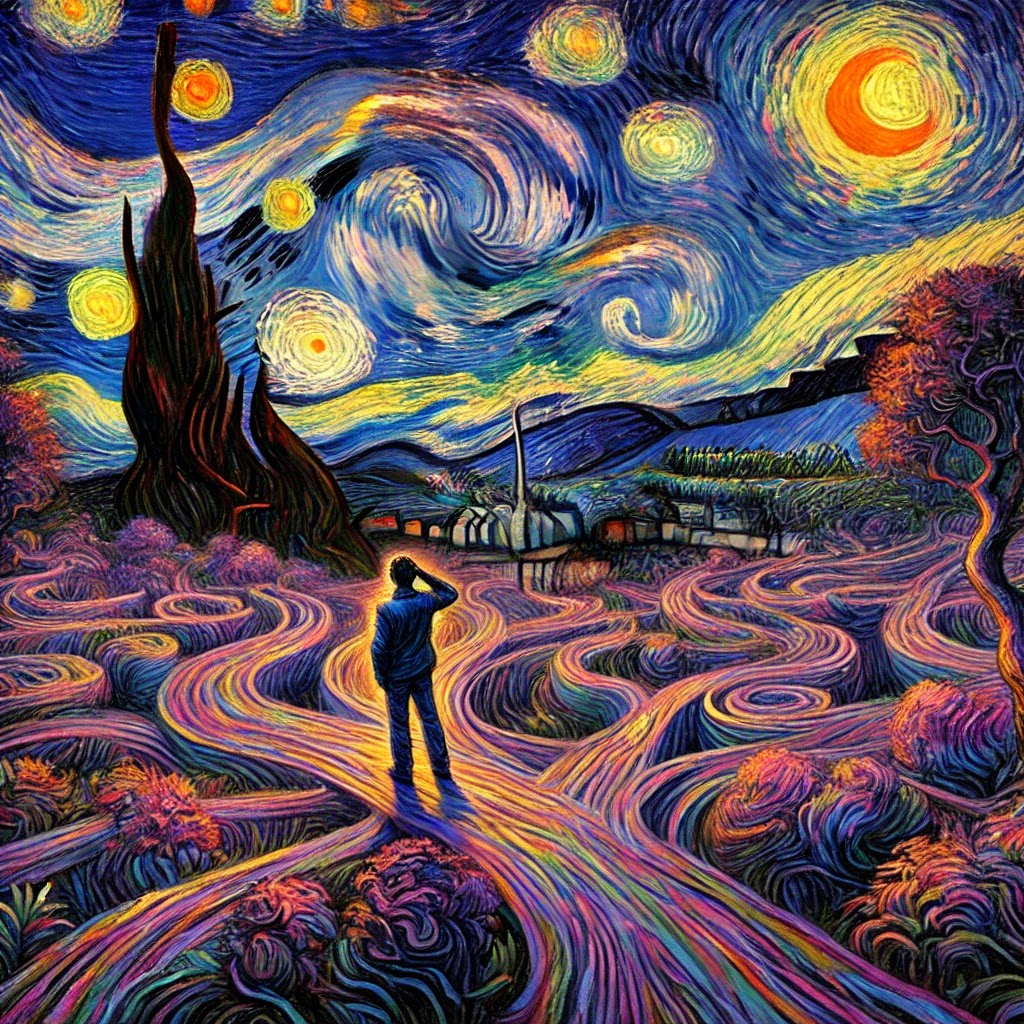
Tapestry of randomness


In twilight's hush, where shadows play,

We wander through a garden's maze,

Where paths unfold, then fade away,

Like whispers of a distant sway.


Each step we take, a choice we make,

The landscape shifts, a new path's stake,

Forking endlessly, like branches high,

A labyrinth born of wonder why.


Yet, we're not sole architects of this maze,

The garden's grown, nurtured by time and grace,

Tended by hands that came before our own,

And those who presently, its beauty have sown.

The garden remembers every footstep light,

Every decision made, in endless night,

The trees, the flowers, the wind, the sun's embrace,

All whisper secrets, of the paths we trace.


In this ever-changing tapestry so fine,

We weave our thread, a moment's design,

A choice, a step, a breath, a heartbeat's pace,

In the garden's heart, a shifting, sacred space.

So let us wander, lost, yet not alone,

For in the garden's depths, a wisdom's sown,

That guides us through, the paths we cannot see,

To hidden truths, and mysteries yet to be.

It’s a Mad Mad World - week ending Sept 28, 2026

  There was a time when the world was divided into two simple categories: sensible things and nonsensical things. Sensible things included ...